
Esto Oculta La Iglesia En La Morgue Donde Trabajaba Historias De Terror - REDE

¡ Rápido ! Suscríbete y activa la campanita.
Se parte de la comunidad REDE.
ENVIAME TUS HISTORIAS A: relatosdesclasificados@gmail.com
SÍGUEME EN FANPAGE: https://bit.ly/33H3Og3
SÍGUEME EN INSTAGRAM: https://bit.ly/3dgiBmd

 Apple Podcasts

 Spotify

 Castro

 RSS Feed
¡ Rápido ! Suscríbete y activa la campanita.
Se parte de la comunidad REDE.
ENVIAME TUS HISTORIAS A: relatosdesclasificados@gmail.com
SÍGUEME EN FANPAGE: https://bit.ly/33H3Og3
SÍGUEME EN INSTAGRAM: https://bit.ly/3dgiBmd
0:05 Camasots. My name is Bastian Betancourt. I' m forty- four years old and I' m from Zapopa. I am a Jew and, as my last name suggests, I have French descent. My grandfather Paterno was the first of the family to come to Mexico. This at the end of August of nineteen hundred and forty- one, after fleeing from the Germans for almost a year. My grandfather lived in France when the shadow of the Third Reich began to spread throughout Europe. My grandfather was a Jew of faith and heart. His life and that of his family were threatened by hatred and persecution. With the German invasion of France in nineteen hundred and forty. They were forced to flee, to leave behind everything known in search of security that faded away with every enemy advance before they managed to leave Paris. Something happened my grandfather or he never told us the details of that moment. The point is, after that thing that he never told us happened, he was left alone.
1:07 He was the only one in his family who made it out of Paris. My grandfather' s odyssey began with how little I could carry. He began his journey to the South, looking for a way to avoid the Germans for months. He moved only during the night, hiding among those willing to help in isolated farms, in forgotten monasteries, always one step ahead of the danger that pursued them. The news that Mexico was accepting Jewish refugees came to him as a beacon of hope. It was very complicated and it had to take almost a year, but finally my grandfather managed to get to Marseille, where a boat would take him across the Atlantic to freedom. The trip was arduous.
1:52 On landing in Mexico, my grandfather described how he felt when he stepped on land, a land that promised security and a new or beginning. The refuge my grandfather found in Mexico was not enough to erase the scars that war and persecution had left in his being. Experiences in France, flight, the constant threat of death marked him deeply. My grandfather' s hardness was nothing more than the armor of a man who had seen too much, a man who had learned to expect the worst to survive. This armor, however, did not protect him alone in his mind was the strength he believed necessary to safeguard his family from the cruelties of the world. The crudest lesson the war taught him was that life could be snatched away in an instant and only those prepared to defend themselves, to fight, could have the hope of overcoming adversities.
2:50 That became a strict education for their children, in which discipline and preparedness to face any threat were fundamental. The la las, the security could only be guaranteed through force. My grandfather was violent with his sons and daughters alike That forged a rather harsh character for all of them. My aunts never got married. They' re both high school principals. As for my uncles some joined the military forces, others, like my father, chose the way of the police. My father' s life as a policeman was marked by his tireless dedication and his firm commitment to justice, values that led him to stand out within his profession. Over time, his reputation grew. In nineteen hundred and sixty- seven, this recognition reached a climax when his superior entrusted him with a mission of great responsibility to fill an important position in Lecumberry prison, known for harboring some of the most notorious criminals in the country. However, my grandfather had a very bad opinion about that prison. I was comparing it to the concentration camps the Germans had, so when my father agreed to work at Lecumberry. They broke relationship forever. Among the chapters of my father' s life is one that is never spoken because it is too strong. In August of nineteen hundred and sixty- eight, several university students arrested by the
4:25 Government arrived in Lecumberry, accused of instigating protests and planning actions against the State. My father, along with others, was entrusted with the task of interrogating these young people as prisoners. Then, when those of October 2 occurred, the brutal repression of the lives of the lost youth, he learned that the government had been able to act in that way because of the information he and others had taken from the university students who questioned in Lecumberry. My father felt so much guilt that he resigned and walked away completely from any work that involved carrying a gun. After leaving his post in Lecumberry, my father studied medicine for three years and then specialized as a forensic doctor, allowing him to work in Semefo. It was there that he met the woman who would become my mother, an embalmer whose ability to treat the deceased with dignity and respect captivated him from the beginning. She shared her vision of forensic medicine, not only as a science, but as a service to the community, providing comfort to families at their time of greatest pain, taking care of their loved ones with a deep humanity, growing up in a home where both parents work with the dead. He gave a unique perspective on life, one that moves away drastically from what many might consider normal or everyday. My childhood was marked by this
5:56 unusual reality, in which death, far from being such a bona fide subject or a feared presence, became a constant component of my education and development. Since before he was old enough to attend primary school, he was already familiar with concepts that other children would find strange or even frightening. Dinners in our house were always accompanied by some anecdote about corpses. This early exposure to death taught me to see it not as the absolute end, but as a natural part of existence. One more step in the interrupted cycle of life. This upbringing made me quite insensitive to death, as well as placing me in a peculiar position with respect to my schoolmates. In a world where children fear monsters under the bed, I didn' t know fear. The presence of death in our home was not limited to conversations during dinner, sometimes especially during the summer, when the or heat intensified decomposition and made its work even more demanding.
7:04 My parents often came home with an unpleasant smell. No matter how many precautions you take, changing clothes or using all kinds of products to clean your hands and face the smell of subtle but unmistakable death. He held on to them mixing with his sweat and emanating from his skin. Obviously, the first time I had to read that I threw up instantly, but over the years I came to take it as the most normal thing in the world. I am very aware of how my parents came to pass, even more than an hour, showering because if not the smell of death, they would not get rid of the body. When I turned thirteen, my parents decided that, even though my father had no relationship with my grandfather, that I was not part of the problem. So they got me on a plane and sent me to Veracruz for two weeks. I was very hopeful that for those two weeks I could forget about death, but it didn' t happen, because my grandfather, all I was talking about was all the atrocities he saw in France during the German occupation. That' s when I realized it didn' t matter where I was or who I was with. For some reason, death was always there in front of me, as if he was trying to communicate with me, as if death was trying to tell me something. Upon returning from those two weeks on the plane, I was already thinking that upon entering
8:35 the university I would study something related to death and so it happened. As I entered the University, I immersed myself in the world of forensic medicine and pathological anatomy, fields that explore death not only as a biological fact, but also as a mystery to be solved. Throughout my studies, every course, every certification, every day I went deeper into the field that revolved around death. I' m a forensic technician, pathological anatomy technician, qualified in medical laboratory technology and certified pathology assistant, but my education didn' t stop there.
9:16 Inspired by the respect for the deceased I saw in my mother and in her work as embalmer, I also obtained a license as a beautician. My foray into the professional world began with my parents, who, thanks to their years of experience and the ties forged in the forensic and medical field, helped me to get my first job. However, I could not last in that job for as long as I would have liked. When I got the news that my grandfather was sick, I knew that my place was next to him supporting my grandmother at that difficult time. I was aware that my father and grandfather had had a distant, complicated relationship, marked by years of silence and misunderstanding, which made it unlikely that my father would come into this situation.
10:09 Moved by the need to be close to my grandfather and the desire to give him my support, I made the decision to quit my job and travel to Veracruz. For the next seven months I spent my time and energy taking care of my grandfather, assisting my grandmother in everything necessary. My grandfather had been a successful man in his business, accumulating a considerable fortune throughout his life. This meant that during my stay in Veracruz, there was no need to worry about working, which allowed me to devote myself completely to his care. One afternoon, my grandfather just got really bad and we had to put him in the hospital. On the third day of boarding school, my grandfather seemed to be getting better. That night he asked my grandmother to look for the doctor to ask him a question. It was an excuse to stay alone with me.
11:03 That' s when, with trembling hands, he gave me a medal. It was an object he had seen hanging from his neck on countless occasions, a symbol he had never fully understood until that moment. The moment he put the medal in my hands, he told me this medal was given to me by my rabbi as a child in France, during the darkest days, when the Germans, when the whole world seemed to have turned against us. This medal was my consolation, my source of strength. He reminded me of where it came from and the light that was in faith and hope. He paused by taking a hard breath. Before we go any further, I want you to take her with you, death. He' s chosen you, and I' m worried about that. You will face moments of evil, moments when you will need to remember that God is on your side. This medal will give you strength, just like it did with me. When he finished his words, he closed his eyes and died. To everyone' s surprise, my father attended the funeral. My grandmother After a period of mourning and reflection, she made a decision that surprised us all. He wanted to move to Oaxaca to his mother' s hometown, a place that, despite never having visited, felt that he should go and stay there until the day of his death. Intrigued by her decision and moved by the desire to support
12:37 her in this new stage, I decided to accompany her on her journey. It was a decision that would not only change his life, but also mine. When we arrived in Oaxaca, we found a landscape that looked like it had been taken from another time. One thing I want to clarify about my grandmother is that she wasn' t Jewish. She was Catholic. However, I know that either he married my grandfather, had not gone to church again. He never converted to Judaism, but he did not go to the Catholic Church. Already when my grandfather died and was in that town of Oaxaca, he began to go to Mass every Sunday. After a week of being with my grandmother all the time, I decided to go out and see if I could find anything interesting to do. If I was going to be there for an indefinite amount of time, at least I wanted to do some activity.
13:31 What I found, however, was something I would never have expected. In the heart of the village, between the houses of Adobe and the paved roads stood a building that distended with the surroundings for its modernity. It was a recent construction owned by the Catholic Church, which housed a morgue and a funeral home. The presence of this facility in such a remote place surprised me, but even more surprising it was to discover that they were looking for someone with a professional profile like mine, the priest in charge of the entire building was a man of about seventy years. When I met him and talked about the needs of love that and the funeral home, I realized that all this was too much for it to be a mere coincidence. After discussing it with my grandmother, who was sure this was the destination, I decided to apply for the job. The acceptance was immediate, something that in any other context had seemed incredibly timely, but that at that time felt like something more like a sign. In fact, at the time I signed the contract, he gave me a little start near my neck, right where I was hanging the amulet my grandfather gave me before the place died. Its facilities, although not private in the strictest sense of the word, operated under a somewhat exclusive model.
14:58 The care and services provided had no cost to the families of the deceased, which represented considerable help in times of deep pain and financial hardship. However, access to these services was conditioned. Only families actively involved in church activities could apply for the admission of their loved ones to the amorgue and then make use of the funeral home for wake services. In addition, the offices and procedures for funeral services were managed by nuns. This whole thing was really weird for me, because I' m Jewish. The scope of these facilities transcended the boundaries of the village. People from anywhere could apply for their services as long as they demonstrated that their family was actively involved in the church. Closer to your home. On the outskirts of town there were three cemeteries. The r the first or, but managed by the municipal capital, served as the public cemetery, a place of final rest for many of the inhabitants of the village without distinction. The other two operated under the administration of the Catholic Church.
16:15 The largest of these church cemeteries was the final destination of those whose bodies had been cared for in the building where he worked. This place was spacious and kept clean all the time. However, it was the other cemetery, the smallest one I had ever seen. The one that caught my attention the most, but not in the good sense of the word. In fact, I was anxious about twenty meters by twenty, a tiny plot of land that kept more questions than buried bodies. No one seemed to know who was buried. There were no accessible records or plates identifying the occupants of their graves. In addition, this small cemetery remained closed to the public, secured with a lock 24 hours a day without a candlestick. This absence of vigilance, combined with restricted access, gave him an even more enigmatic atmosphere as if beyond being a mere place of rest, he was the guardian of some ancient secret that the Church, for unknown reasons, preferred to keep hidden. The Church administered it under a lot of hermetism. The existence of this cemetery and the many unanswered questions surrounding it became an obsession. For me. In my free moments, I was contemplating that closed space. From the first time I noticed that at the top of the entrance gate of the small cemetery, where the name of
17:48 the place is supposed to be, the only thing there was a metal bat keep that in mind. Now, about my work, most of the time it was going to be in complete calm. My days were 13 hours from Monday to Friday on Saturdays. In respect of my Jewish beliefs and practices, I did not work taking advantage of this day for rest and to spend time with my grandmother. On Sundays he did not work either, because they were days when the priest in charge of the facilities and the nuns dedicated their time to the activities of the Church of the People. My activities were divided between the meticulous preparation of the bodies for their wake and a variety of essential activities in the morgue. Sixty percent of my time devoted to preparing the bodies for their wake. It was a job that required both technical skill and sensitivity and respect for the deceased and their families. Every body that came to our facilities had its own history and my task was to ensure that they were given a dignified farewell that reflected the care and respect they deserved. The other forty percent of my time was spent in the morgue, where my responsibilities were varied.
19:11 Obviously, I wasn' t the only worker in the place, but I was the only one who worked both at the funeral home and at the morgue. This was because part of my responsibilities included supervising the other people involved in the handling of bodies, ensuring that the highest standards of care, respect and compliance with health protocols were maintained. Despite my ample freedom to move and supervise within this morgue and funeral complex, there was a notable exception that from the beginning aroused my curiosity. It was a restricted corridor at the back of the building, to which only the priest had access. The most intriguing thing about this hallway was not only its restriction of access, but the strict rules.
20:00 Cleaning staff who kept the rest of the building in an impeccable condition were forbidden to enter to perform even the most basic tasks, such as moping the floor or collecting fallen papers. If something was out of place in that corridor, the only one who could rectify it was the priest. This policy of non - intervention on the part of all but the priest himself was very mysterious and for some speculation about what was really at the bottom of the corridor. The corridor ran straight for about ten meters and then turned left on the ten meters that were visible. There was nothing, it was just a hallway. Whatever was turning around was a mystery because it was out of sight. It was very strange. After more than a year working in this place, the restricted corridor remained a mystery. However, one day, at a time as ordinary as any other, as I passed in front of the hallway and turned I looked at the priest I was just turning left in the section of the corridor that was hidden in sight, carrying in his hands an open Bible and approximately ten rosaries. The surprise of finally seeing some activity in that corridor was as great as the curiosity that aroused me to see the objects that the priest carried to him. I am Jewish, for it is obvious that I am not so familiar with the practices carried out by Catholic priests. However, the little
21:34 I know is that the Bible and rosaries are used to carry out prayers with different motives. Seeing that just gave me more questions. The building had several chapels, so it' s not like the priest had no other place to pray. That day, after finishing another long 13- hour day, as I was leaving just before crossing the street, my attention was captured by an unusual scene. A black van with an imposing appearance and clearly different from any vehicle I had seen in the village, entered the premises and headed towards the back of the building, an area that I had until that moment only seen access to the vehicles responsible for collecting the biological residues of Amorgue moved by a mixture of curiosity and an inexplicable feeling that I was about to discover something with caution. I approached the back of the building, hiding behind a pole to observe without being seen from my hiding place, I witnessed a moment that will remain engraved in my memory. The men who descended from the van proceeded to lower a body during the process. A careless move caused one of the body ' s arms to be exposed. His arm was almost skeletal of a paleness so exaggerated that he had never seen it on a corpse before. In addition, the arm was marked by veins and arteries that stood out in a deep,
23:04 disquieting black color. The men introduced the body to the building through the door intended to take out the garbage. Then they returned to the van and walked away with the same discretion they had arrived with. This incident left me with a feeling of bewilderment and with more questions than the many who already intrigued me in the three days that followed that unexpected and disconcerting sighting in the back of the building, The presence and activities of the priest became the object of my attention. Despite keeping my usual tasks, a part of my mind remained alert, almost waiting to see again some sign that would give me clues about the mysterious event I had witnessed Curiously, during this time I did not see the priest again near the restricted corridor. However, his presence did not go unnoticed in other areas of the building, particularly in the offices. On the four or five occasions I saw him, he always carried the same open Bible and the ten rosaries. This observation led me to contemplate several possibilities. The persistence of the priest in carrying these religious objects with him, even at times when he did not seem to be heading for the restricted corridor, suggested a constant preparation or expectation, as if at any time he might need to access
24:36 that place to accomplish something. A week later, a man came to the facility whose clothing was of greater importance than that of a common priest. Upon inquiry, I was informed that this was the Bishop, which immediately raised my level of curiosity and speculation about the nature of his visit. In addition, I discovered that the Bishop had visited the sonic lur only three times during the six years that the facilities had been operating. The presence of the Bishop in our facilities, especially considering the context of recent events he had witnessed, could not be coincidental. The visits of a figure of such a hierarchy within the Catholic Church suggested that something had happened, that something was happening or that something was going to happen. The two months that followed the Bishop' s visit passed without incident. However, the apparent calm was abruptly interrupted by the arrival of a visibly altered marriage. That day, my visit to the offices had a simple purpose of reviewing a necessary file for one of my tasks in the morgue. I did not expect to meet in the midst of a heated discussion between that marriage and three of the nuns, especially because the nuns were very serious. I never imagined I' d see them argue like that. Although my intention was not to meddle in other people' s affairs, it was impossible not to perceive the atmosphere of despair that carried the marriage and by the
26:10 time I was retiring. What I had understood was that the discussion seemed to revolve around the disappearance of your son' s body. I could not hear well, but the marriage seemed to be very sure that the body had been moved to our morgue. I could have ruled out this encounter as another tragic case of a family seeking answers on the whereabouts of a loved one. However, just as the door closed behind me, the last echoes of the conversation I managed to grasp included the mother uttering the word exorcism. That word left me icy. Honestly. I do not know the context in which Catholics contemplate an exorcism, but at least within Judaism. That' s a very serious thing, so the fact that this marriage was looking for your son' s body and that an exorcism was also mentioned seemed to suggest that the cause of your son' s death was demonic possession. But as I walked towards the morgue and already with the file in my hand, I wondered what that exorcism had to do with our morgue. As I told you before, they only entered bodies if the family requested it and if the parents were so upset looking for their son' s body, claiming that they had taken him to our morgue, because apparently that was a sign that they had not asked the body to be admitted to the place. Besides, I was in charge of signing the death certificates. I was making sure that the cause of death noted was
27:41 the right one, and I' m sure I never signed a paper that said someone' s cause of death was for exorcism. So something weird was going on with the marriage thing. Arguing with the nuns. He spent one Friday the next day, following my rough Saturday routine, I left home where I lived with my grandmother at six in the morning to take a walk all over the village. It was my weekly exercise. Like I said on the way out of town were the three cemeteries. Then, as I did, the walk along the shore of the village, evidently passed in front of the cemeteries. That Saturday, at the time of my approach to the small cemetery, the one that remained locked twenty- four hours a day and whose gate was guarded by the figure of a metal bat. I stopped because I saw something that was already the drop that spilled the glass the marriage that was in the offices. The day before, arguing with the nuns, he was leaving the cemetery and they were not alone. Next to him was the priest who ran the facilities where he worked to see them together. Leaving that place, he made me start putting together all the pieces of the ro puzzle, suggesting a direct connection between the dead son of the marriage, the corridor to which I could only access, the priest, the body they put in the back and that cemetery. I decided to discreetly follow the marriage until the bus stop
29:17 leading to the municipal head office. There I approached them I told them that I worked in the morgue, where they had sought out their son the day before. I told them I couldn' t help but hear the discussion they had with the nuns and wanted to know what was going on, because maybe I could help them. They told me that, six months ago, their son had begun to show signs of demonic possession, which led them to seek help in their local church in Guanajuato. The church, through the bishop of the area, had sent an exorcist to treat the young man, but despite his efforts, they failed to save him and the boy died. They accepted the church' s offer to take care of the expenses of these funeral homes in exchange for allowing an autopsy, without imagining that it would mean losing all traces of what had happened to their son' s body. Their determination to discover the truth led them to confront the bishop responsible for sending the exorcist situation that culminated in violence when the bishop refused to want to give them any kind of information. After the husband beat him a few times, the bishop, perhaps in an attempt to appease the situation or to get rid of the problem, sent them to this remote town in Oaxaca, to the Morgue, where I worked. After a long and frustrating discussion with the nuns, they were finally received by the priest, who confirmed the practice of receiving bodies from those
30:47 who did not survive the exorcisms, but insisted that his son' s body had not arrived there. The visit to the small cemetery was the final test offered by the priest, showing them that, although indeed, bodies of failed exorcisms were buried there. His son' s name was not on any of the tombs. After hearing their story, I offered them my help to find what they were looking for so much. I assured them that, contrary to the priest' s statement, the body of his son had indeed arrived at our morgue and that he believed he knew exactly where we could find him. However, aware of the restrictions and secrets surrounding the place, he knew that any attempt at access would have to be carefully planned. I asked them to go to sleep at their hotel in the municipal capital, but to return the following day in the afternoon, which was Sunday. I explained to them that on Sundays the only person present in the building was the Security Guard who looked after the night and morning, which I knew well we were friends, so with the right excuse, it would allow us to enter without raising suspicions the marriage. He accepted reggas to leave the village in the afternoon of the following day, as the marriage got on the bus. I went back to the house on Sunday night. My plan came in It was simple. I would arrive with the marriage to the building shortly after midnight and using a credible excuse, convince the Security Guard to allow us access. What I told my friend
32:21 was that the marriage had had a funeral service last week and that they had forgotten to pick up their reading credentials, so I would take them to the offices to pick them up and in less than twenty minutes we would be gone it worked. He let us in next to the marriage. We headed for the forbidden corridor, the one that had remained out of reach of me and of all, except the priest. We walked the ten meters until we reached the turn, where the corridor turned to the left. There we find a door marked by a metal bat identical to the one that adorned the entrance of the small cemetery. That coincidence only intensified the feeling that we were about to discover something important. By opening the door, what we saw inside challenged any expectation. A room dominated by a huge altar at the top of which lay a possibly obsidian black stone figure, with an indigenous representation of a half- human entity, half- bat. The most disturbing thing was the hieroglyphics covering every inch of the walls, floor and ceiling, an unknown and ancient writing.
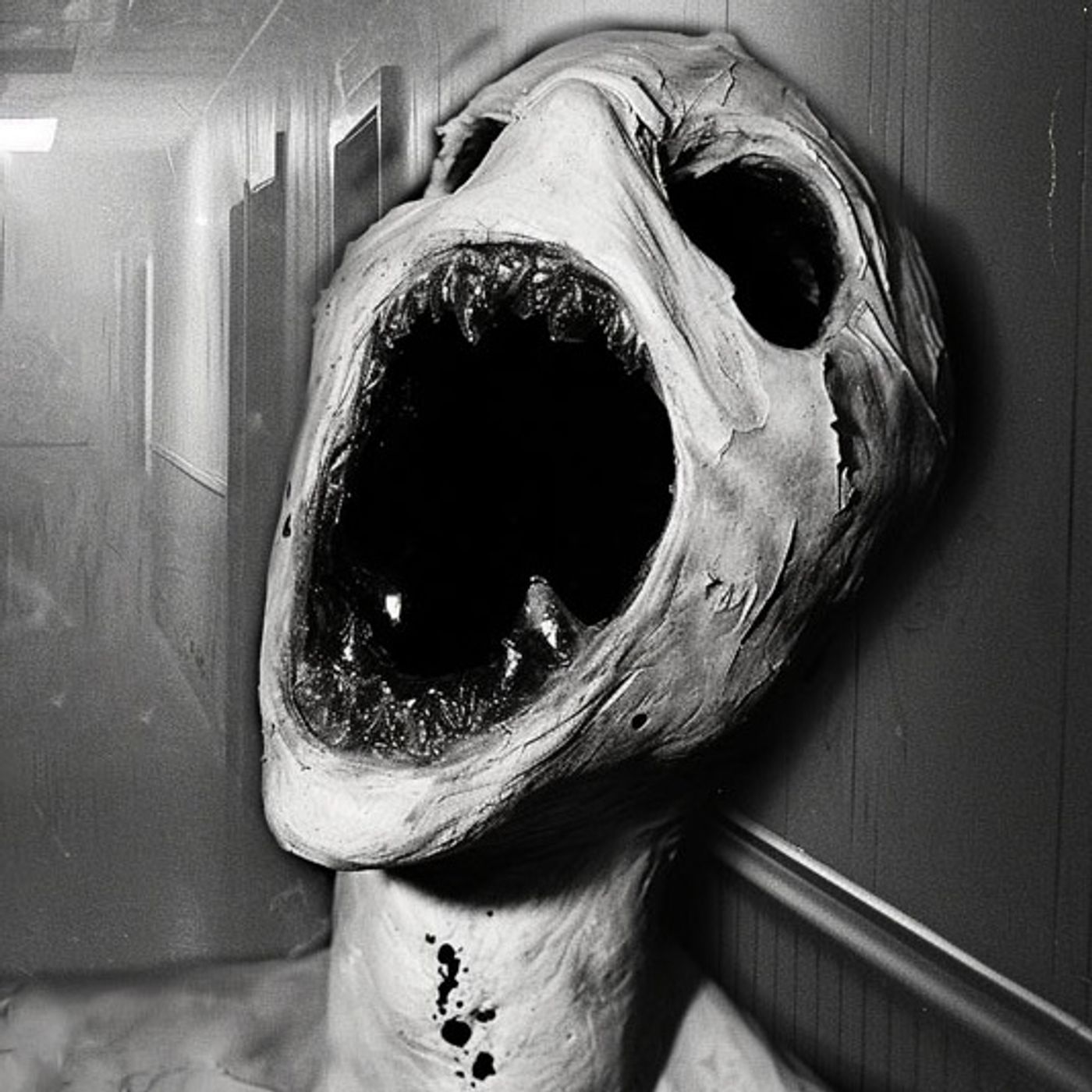
33:36 Most likely I had never seen anything like it and there in the middle of the room, on a stone plate, lay the body I had witnessed, being secretly introduced days ago, pale with veins and arteries marked in a deep and disturbing black. The recognition of the body by the marriage was instantaneous and tearing. There was no doubt that the body belonged to his son. Confirmation left all three of us in a state of shock. My mind was still struggling to assimilate the hieroglyphs that covered every surface of the secret room. When something happened that challenged all logic and understanding, as the marriage approached the body of her son, the mother stretched her hand toward the forehead of the corpse, but at that time the body opened her eyes and stared at her.
34:30 Then the corpse stretched out his arm and grabbed the mother' s hand with supernatural force, preventing him from retreating. Things got even worse When the corpse spoke, said a word Kamazots, the husband and I, pulling with all our strength, finally managed to free the woman from the body' s grip and without looking back, we ran at full speed Out of that cursed room and out of the building l s s s. S l. S R. On the street, the guard could do nothing but get separated in confusion, watching us drift away at full speed. My desperate flight along with the marriage became a tragedy in a matter of seconds. As we ran down the street trying to put as much distance as possible between us and the horror we had just witnessed out of nowhere, a car ran over the woman with a force that was evident that her husband had killed her. She ran to her horrified and as we could, we called an ambulance, hoping that she could survive that accident, But it was clear that the woman had already died the husband was only stuck near his wife' s body crying inconsolably. The security guard came a little closer to the crash site and I was just looking away at the situation, constantly looking at the facilities and everywhere in case that demonic corpse didn' t follow. I just left the place before the authorities
36:04 arrived. I went to my grandmother' s with the intention of not returning to that place. I didn' t even file a formal waiver. I just stopped attending, avoiding calls to ask myself what had happened. I have no explanation for what happened. I have no idea what the word Kama sots means. I have no idea of any story written and adapted by Ramiro contreras